
Criminal Cases in Kit Carson Courts
Kit Carson County Combined Court places two trial courts at one Burlington counter. District Court hears felonies. County Court hears misdemeanors and traffic cases. Their clerk maintains filed complaints and informations, docket entries, warrants, pleadings, orders, judgments, sentences, and payments. Sharing a building does not merge the case classes. The case number and court type identify which judge and jurisdiction control the file.
Burlington Municipal Court is separate. It handles city ordinances and municipal traffic matters at its own courthouse and keeps its own records. A Burlington citation therefore may not appear in a Combined Court request. Start with the issuing paper or agency, then match the matter to municipal, county, or district jurisdiction. Federal cases also sit outside this chain and use the U.S. District Court and PACER.
Kit Carson Docket Search Limits
The Colorado Judicial Branch Docket Search is a free hearing finder prefiltered for Kit Carson County. It requires a date choice plus at least one more filter. A result card can show the hearing date and time, estimated length, party, case number, hearing type, courthouse, appearance type, and courtroom. It does not reveal the full charge list, plea, bond, disposition, sentence, financial entries, or downloadable pleadings.
The official docket interface is visible in the source below. Its narrow result schema is useful because it sets the right expectation: locate the hearing and case number online, then use the clerk for the record itself.
View the official Kit Carson docket search source.
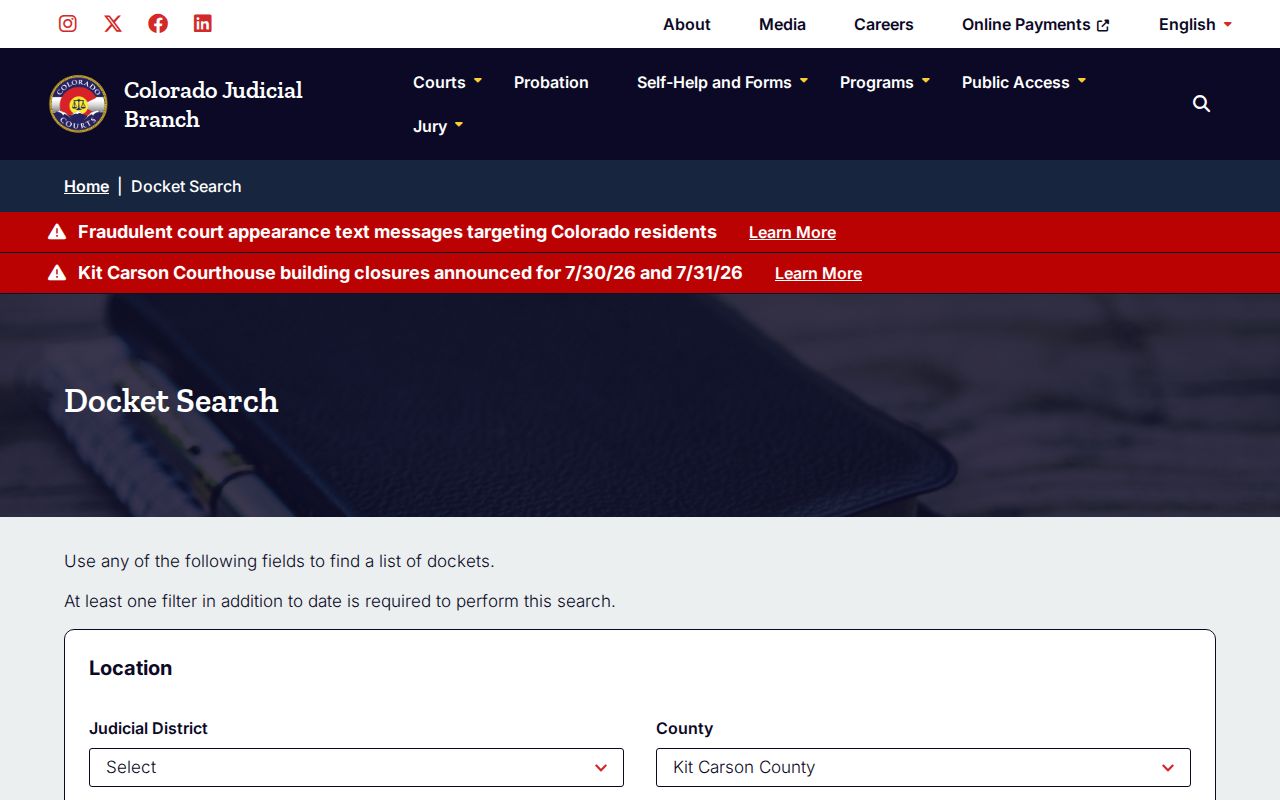
The county and court filters reduce false matches, but a hearing label alone never states how a charge ended.
How to Search Case Records
Use the online tool to identify the matter, not to replace the clerk’s file. Names can collide, and older material may not surface in the same way as a current hearing. A case number is the strongest bridge between the portal and the official record.
- Open the Judicial Branch Docket Search and select Kit Carson County, the Combined Court when useful, and a date range.
- Add a party name or enter the year, case class, and sequence from a known case number.
- Narrow the court type to County or District if the alleged offense level is known.
- Read the result for the case number, hearing type, courtroom, and appearance instructions.
- Email or call the Combined Court clerk with the number, approximate year, party name, and exact copies needed.
| Field | Input | Required | Use |
|---|---|---|---|
| Date range | Preset or date | Yes | Six months through one day |
| County | Dropdown | One location filter | Select Kit Carson |
| Court type | Dropdown | No | Both, County, or District |
| Case details | Year, class, sequence | No | Best for a known number |
| Party | Name or business | No | At least one extra filter is needed |
| Attorney | Name or bar number | No | Alternative search route |
Requesting the Kit Carson File
The Kit Carson County trial-court page expressly permits a record check by email. Contact KitCarsonClerksOffice@judicial.state.co.us, call 719-346-5524 extension 3, fax 719-356-6525, or visit Suite 301 at 1650 Donelan Avenue, Burlington, Colorado 80807. Public hours are weekdays from 8:00 a.m. to noon and 1:00 to 4:00 p.m.
Give the full name, approximate year, case class or number if known, and a precise document list. Ask for a cost estimate and whether delivery can be remote. Plain single-sided copies follow the statewide $0.25 page rate, double-sided copies are $0.50 per page, and certification carries a $20 charge. Do not send the sheriff a request for judicial pleadings. The sheriff and court are separate custodians.
See the official clerk contacts and court access details.
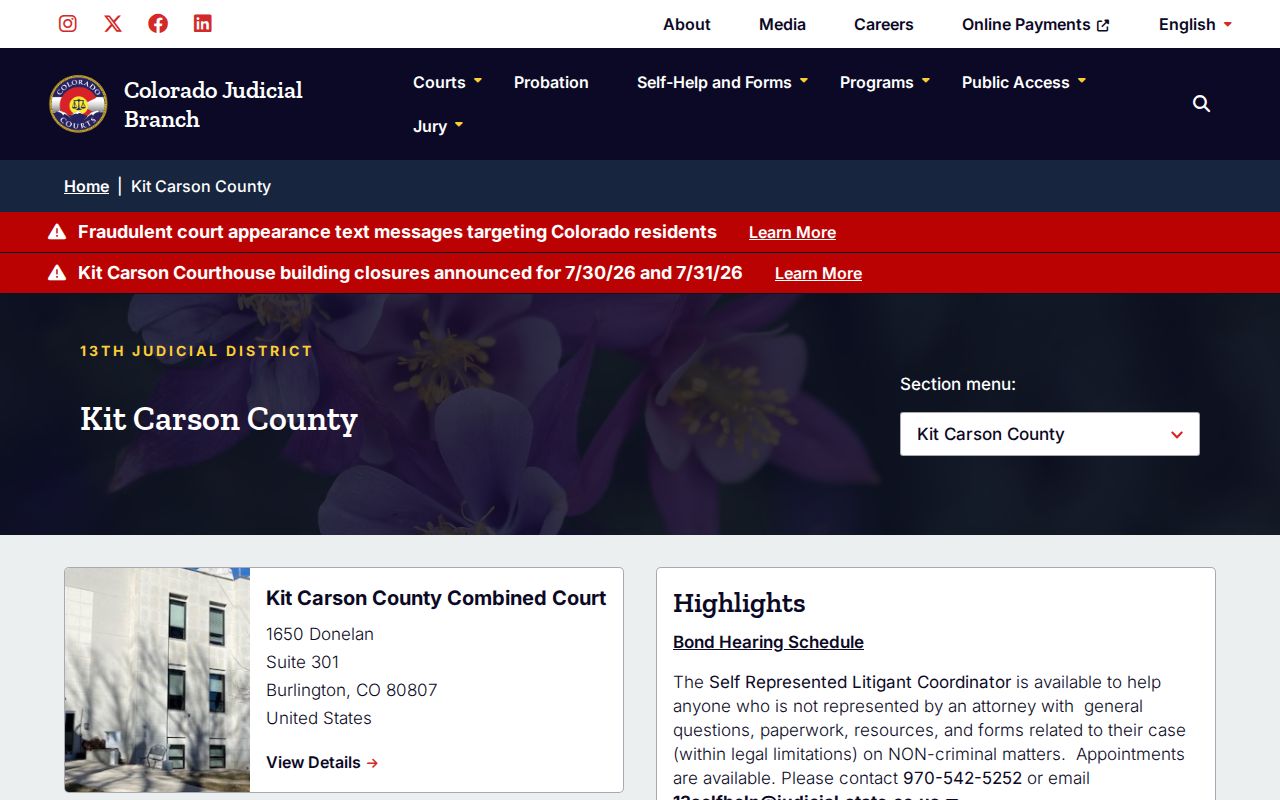
The email channel is especially useful for an older file or a docket result that lacks the needed disposition.
What the Kit Carson Case File Shows
A court case file is document-rich. It records what prosecutors filed and what the judge decided. It differs from a CBI rap sheet, which organizes fingerprint-supported arrest cycles, and from a jail booking entry, which concerns intake and custody. Review the actual charging paper and final disposition together.
| Case Number & Court | Identifies the year, case class, sequence, and County or District Court jurisdiction. |
|---|---|
| Charging Document | Complaint, information, or indictment stating the filed allegations. |
| Docket Entries | Chronological filings, hearings, orders, and other recorded events. |
| Hearing Dates | Past or scheduled proceedings and their stated purpose. |
| Disposition & Judgment | The outcome for each charge, such as dismissal, acquittal, deferred result, or conviction. |
| Sentence & Conditions | Penalty, custody, probation, restitution, and other orders when applicable. |
A docket is the event list. A disposition is the outcome. An arraignment is where filed charges are addressed and a plea is entered. A deferred judgment delays judgment while conditions are completed and can end in dismissal. These terms should not be treated as synonyms.
Kit Carson’s Three-Suite Court Campus
The county justice offices share 1650 Donelan Avenue but occupy distinct suites. Combined Court is Suite 301, the sheriff and detention center use Suite 103, and probation uses Suite 104. The official Combined Court location record confirms the court building and contact point.
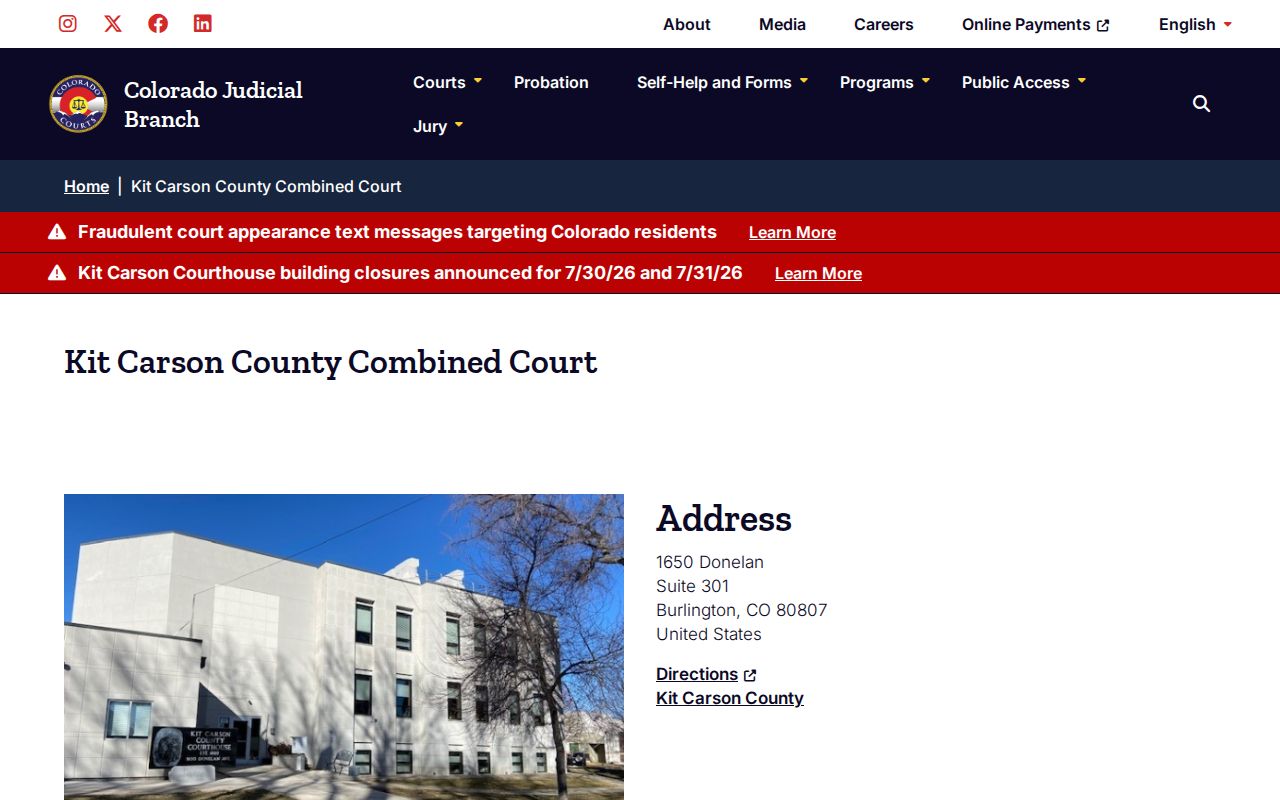
Visitors enter through the south door and pass an electronic scanner. Leave sharp or questionable objects outside. Being at the right street address is only the first step; Suite 301 is the counter for the filed court case.
First-and-Third-Tuesday Court Calendar
Kit Carson County’s calendar gives searchers a practical clue without replacing the docket. County Court traffic and misdemeanor matters are generally heard on the first and third Tuesdays at 9:00 a.m. In-custody advisements are held on a separate daily calendar. A result near one of these settings may help a reader select the right date window or explain why a hearing card has appeared.
Calendar placement does not reveal the charge outcome. A hearing can be reset, continued, or followed by later proceedings. Confirm the assigned courtroom with the clerk, and inspect the docket entries and final order before treating the event as resolved. The court states that ordinary appearances remain in person unless virtual permission is granted, so the appearance-type field should be read with the current court instruction.
Stages of a Kit Carson Case
A local case may begin with an arrest or summons, followed by advisement and a bond decision. The prosecutor then files a complaint or information, or a grand jury returns an indictment. Arraignment, motions, pretrial hearings, and a plea or trial lead to disposition. Sentencing follows a conviction, and an appeal may follow the judgment.
Case flow: Charges Filed › Arraignment › Pretrial › Plea or Trial › Disposition › Sentencing
Kit Carson’s verified in-custody advisement calendar runs daily at 2:15 p.m. by Webex. County traffic and misdemeanor settings generally occur on the first and third Tuesdays at 9:00 a.m. Those calendar facts explain when a case may appear, but they do not predict its result. Ordinary appearances remain in person unless the court grants permission to appear remotely.
Reading Kit Carson Case Outcomes
A dismissal means a filed charge ended without conviction. An acquittal is a not-guilty adjudication. A conviction creates a judgment and sentence. Each charge can have its own result, so a case-level label may hide a mixed outcome. Read the disposition beside the charging document and later orders.
- CR case class
- Commonly identifies a District Court criminal matter.
- M case class
- Commonly identifies a County Court misdemeanor matter.
- Disposition
- The final result entered for a specific charge.
- Sentence
- The court’s penalty and orders after conviction.
If CBI shows an open arrest cycle after the court resolved it, obtain a certified disposition and use CBI’s update process. Correcting the reported outcome is different from sealing. A dismissal does not by itself make every public copy inaccessible.
Kit Carson Case Access Restrictions
Colorado court records follow the Judicial Branch public-access policy, while criminal-justice agencies also operate under the Colorado Criminal Justice Records Act. Public access does not expose every field. Social Security numbers, financial accounts, protected victim details, information about minors, sealed material, and specified juvenile records may be withheld or redacted.
An online omission can mean the portal is only a hearing finder, the matter is older, no hearing falls in the chosen date window, or access is restricted. It is not sound proof that no case exists. Ask the clerk whether a public record can be identified and what form of access is available. A sealing order restricts ordinary public access, but authorized courts, prosecutors, and law enforcement may retain lawful access.